


Important Biomechanical Parameters
Why are millimeters important?
The bony vertebral bodies are the primary load-bearing structures of the spine. Bone is an anisotropic material, exhibiting different mechanical properties when loaded in different directions. It is strongest and stiffest in compression. Bone remodels in response to the mechanical demands placed on it i.e. cycling, which are affected by the external loads as well as the muscle loading. Within the dense cortical shell of the vertebral body is the cancellous bone of the trabecular system. The trabecular system can be considered as a structural frame supporting the outer cortical shell of the vertebra. The natural synovial joint is a type of mechanical bearing. The lubricant (synovial fluid) and the bearing surfaces (articular cartilage) form a bearing system, which has excellent performance under the loading conditions encountered in normal human activities. That changes with cycling. The vertebral facet joint is a type of synovial joint and is the only synovial joint of the spine.
Synovial Fluid
Synovial fluid is highly non-Newtonian as it rapidly decreases its viscosity at high shear rates i.e. spine angle over the top tube. Some form of elastohydrodynamic or micro-elastohydrodynamic mechanism occurs as the joint moves, which helps to maintain a fluid film between the articular cartilage of the two bones. The high viscosity helps to maintain a fluid film by resisting squeezing out with the joint at rest.
Articular Cartilage
Articular cartilage is the structural material of the bearing. Along with lubricating synovial fluid it allows articulating joints to move and support loads without wearing. This biological system is more efficient at lubrication than any man-made material.
Articular cartilage comprises 80% water, with the remaining 20% made up of a collagen fiber network and proteoglycan matrix. This can be modeled as a biphasic material in which the initial application of a load results in a change in geometry of the material and pressure gradients being set up in the fluid phase of the material. These pressures cause fluid flow out of the cartilage resulting in a second phase of deformation. This resistance to flow is controlled by the permeability of the cartilage and the hydrophilicity of the proteoglycan matrix.
Articular cartilage is viscoelastic and has an ultimate compressive stress of 5MPa.
Ligaments
Ligaments work as passive tensile restraints, controlling the separation of their attachment sites. Mechanical properties of ligaments are expressed graphically as load-elongation curves. Two distinct regions can be identified: At low loads, the 'Toe Region' has minimal stiffness associated with the 'crimp' pattern exhibited by collagen fibrils. As the load is increased, fibrils begin to straighten and these 'crimps' begin to decrease. Once the crimping has been removed, the load-elongation curve becomes a straight line signifying a constant stiffness and this region is referred to as the 'Linear Region”. The stiffness of this region are the values most often reported in the literature. The ‘ultimate load’ is the load at which the ligament is defined to have failed. This is typically the peak load. The area under this load-elongation curve is the energy absorbed by the ligament.
Material properties of ligaments are described in terms of stress-strain curves. These can be obtained from the load-elongation curves of the whole ligament normalized with the geometry of the ligament by the ligament length and cross-sectional area. These curves have a similar shape to the load-elongation curves. The stress-strain curve is geometry independent and modulus, ultimate stress, and ultimate strain values are obtained.
At low loading rates ligaments are viscoelastic structures: they display time- and history-dependent behavior. This is displayed in two ways: stress relaxation and creep . With time, the stress required to hold a ligament at a constant length will decrease to a steady value (stress relaxation), and with time, the length of a ligament will increase to a steady length as a constant stress is applied to the ligament (creep). This may lead to creep rupture. Essentially, the viscoelastic nature of ligaments is due to fluid flow. At high rates there is not sufficient time for the fluid to flow. At rates, such as those associated with traumatic events, ligaments behave elastically.
Ligament properties change with age. Linear stiffness, ultimate load and energy absorbed to failure all decrease with increasing age.
Intervertebral Discs
Intervertebral discs are the primary motion structure between the vertebral bodies (note that there is no disc between the occipital (C0) and C1 and between C1 and C2). The disc is not a synovial joint. It consists of three distinct parts: The centrally located nucleus pulposus, which is a loose and fibrous network accounting for 30-50% of the disc surface area. The annulus fibrosus, in which the outer fibrous portions are arranged in concentric bands like a tree trunk; these adjacent bands are oriented at 120º to each other. The third part is the end-plate which is composed of hyaline cartilage and connects the disc to the vertebral bodies.
Intervertebral discs are viscoelastic structures, which exhibit creep when a load is applied and held constant i.e cycling for hours. The observation that we are several “millimeters shorter at the end of the day” is attributed to the creep behavior of the discs. If there is too much load on the spine at the start of the ride, creep will add more load at the end of the ride. It is important to maintain a light stretch to reduce the creep behavior of the discs, but not too much with longer rides!
Mechanical and Material Properties
The properties of a structure, such as the vertebral column, are referred to as mechanical properties. Mechanical properties include the load-displacement behavior, stiffness, ultimate load and energy absorbed to failure. Another term for mechanical properties is 'structural properties'. Material properties are the structural properties that have been normalized for geometry, and are thus a more general description of the properties of the material itself. Material properties include stress, strain, Young's Modulus (related to stiffness) and strain energy.
Vertebral Coordinate Systems (VCS)
Coordinate systems are used to quantify the direction of load and motion. The specific definition of a coordinate system is arbitrary, but in order for scientists to compare their results a common coordinate system is desired. Unfortunately, a standard coordinate system for the spine has yet to be established. We present the coordinate system adopted from White and Panjabi (1990).
In the VCS, the origin lies in the center of the vertebral body. The X-axis is to the right, the Y-axis is in the cranial direction, and the Z-axis is in the anterior direction.
Loads and Displacements
The loads on the spine can be described as either linear (Force) or as rotational (Moment) or more important a combination of both.
Force - The three primary components of a force are compression, tension and shear. With respect to the vertebral coordinate system there are three independent forces along each of the coordinate axes.
Moments - Moments (M) or torque are couples of equal and opposite force (F) that act at a distance (D), defined simply as F x D = M. With respect to the VCS there are independent moments. A positive moment about X, for example, produces flexion.
Displacement of the spine is complex, three-dimensional, and varies with the level and posture of the spine i.e. over top tube and ones leg rpm. As with loads, displacements can be described as linear, rotational, or a combination of both. Your spine posture should change given the loads you place on it.
Linear - Linear motion is a translation of the vertebral body and there are three independent directions of translation each along an axis of the VCS.
Rotational - Rotational motions can occur about each axis of the VCS and in combinations.
Viscoelasticity
Viscoelasticity is time-dependent elastic behavior. Viscoelastic behavior is typically associated with energy loss through dissipation of heat and/or the flow of fluid. The energy loss of the load-displacement is the area enclosed by the load-displacement curve and is termed hysteresis.
Viscoelasticity is typically quantified with two types of experiment. The load-displacement relation defines recall, material and structural behavior. With viscoelastic behavior time is the third variable. Therefore, experiments to explicitly study viscoelasticity hold one of these three variables constant. In a ‘ creep test ’, a fixed load is applied and the resulting displacement over time is recorded. i.e. laying on our back with hips against a fixed wall. In a ‘ stress relaxation test ’, the displacement is fixed and the resulting decrease in stress or load over time is recorded. This allows us to find a truer spine length.
Physiological Cross-Sectional Area
Muscle strength and loading is difficult to quantify, as direct measurement of muscle forces is currently impractical. A number of different approaches for quantification of muscle forces have been applied in the literature. Electromyography can indicate the intensity of muscle activation, but it is not yet possible to determine accurately the force exerted by each muscle in a complex. One approach is to relate a muscle's ability to generate force to its size and architecture. Cross-sectional area has been used to measure force ratios. The physiological cross-sectional area (PCSA), (cross-sectional area of the muscle perpendicular to all of its fibers), is however believed to provide a better estimation of muscle strength, being proportional to the number and cross-sectional area of the tension-producing fibers. The PCSA can indicate the contribution of each muscle in a group of muscles, particularly when they reach a limiting stress, such as in strenuous activity.
Joint Mechanics
The Spine as a Whole
The spine is comprised of vertebral bodies joined by the intervertebral disc and various ligaments. The spine consists of three general regions: cervical, thoracic and lumbar. Each region possesses unique anatomical characteristics and mechanics. Some characteristics transform continuously from region to region while other characteristics are distinct for each region. The smallest spinal unit of each region is the functional spinal unit FSC. Note that the anatomy and mechanical properties of the spine vary with the spine region.
Typically, female anatomy and material properties vary less than those of males. Typically, female upper body anatomy is less in weight and size. The upper body acts as a counter weight for the legs to work. They do better to load their spine and achieve a lower position over the top tube.
Age can also dramatically decrease the mechanical properties. Functional spinal units are addressed when we have the intervertebral disc and various ligaments, nervous tissues, connective soft tissue all move to their limit of constraints. This is when the spine reaches its limits of the applied load (Units deg or mm) and stiffness (Units N/mm or Nm/deg) with extension This double–action locks the joint, as the ligaments do not elongate further. Exceeding this limit affects the handling, the ability to adjust to the terrain, breathing, etc…
Functional Spinal Unit (FSU)
A functional spinal unit consists of an inferior and superior vertebral body and all of the connective soft tissue between them. Contractile and nervous tissues are excluded. An FSU is the smallest functional unit of the spine below C2
Motion Descriptions
When the motion of a functional spinal unit (FSU) lies within an anatomical plane of the vertebral coordinate system (VCS), the planar motion is relatively straightforward to describe. Planar motion is often a combination of rotation and translation. One approach to describing planar motion is to define a rotation angle and a center of rotation (COR). These two variables completely describe any planar motion. Throughout a range of motion, the COR may be fixed or may move with the degree of motion.
When the motion of an FSU is not planar, describing the 3D motion completely is non-trivial. We prefer to use the helical axis of motion (HAM) variables, also known as the screw axis. The HAM variables consist of a rotation (theta) about and a translation (t) along a unique axis in space. Typically, the HAM translation for normal spine motion is minimal. When the spinal motion is planar, then the HAM axis is perpendicular to that plane of motion and the point of intersection of the HAM axis with the plane of motion is the COR.
Coupled Motions
Coupled motions are defined as motions that are not in the principal direction of the applied load; they are inherently coupled to the principal motion. For example, loading that produces left lateral bending can also produce axial rotation and flexion. The axial rotation and flexion are coupled to the lateral bending and in the healthy spine these motions cannot be separated.
Functional Spinal Unit (FSU) Mechanics
The mechanical behavior of the FSU is described by the relationship between the applied loads and the resulting motions. This relation is often non-linear.
Range of Motion (ROM)
ROM is the motion that occurs between the limits of the applied load (Units deg or mm). The loads from big gears and creep in a 40K are not the same vs. the long haul (many hours).
Stiffness (K)
The K is the slope of the load-motion curve (Units N/mm or Nm/deg). It is important to define at which point on the curve the stiffness is calculated. Typically it is defined in the secondary region of the curve where stiffness is constant over that range.
Neutral Zone (NZ)
The NZ is the zone between opposite directions of loading within which the stiffness is minimal. Physically this corresponds to a zone of “joint sloppiness” or laxity. The NZ is calculated in a variety of ways, but most commonly it is defined as the motion occurring below a given low load “Sweetspot” of the saddle & tilt or as the motion between the two X-axis intercepts of the extended secondary.
Occipital-Atlanto-Axial Region
The occipital-atlanto-axial region of the spine is certainly the most unique region of the spine and is often referred to as the C0-C1-C2 joint. The significant mechanical interaction directly between C0 and C2 necessitates that this region be considered as a single functional unit. In this joint there are no vertebral discs and the articular surfaces and the ligaments are the primary components maintaining the structural stability of the joint.
The superior articular surfaces of C1 are cupped to accept and articulate with the occipital condyles, while the inferior surfaces of C1 are flat and sloped medially to laterally and articulate with the superior articular surface. This shape helps to confine the axis of rotation of C1 relative to C2.
The two primary ligamentous structures of C0-C1-C2 are the transverse ligament and the alar ligaments. The transverse ligament is the posterior restraint of the dens of C2 and has a cross-section of 18mm 2 and a length of 20mm. It is one of the strongest spinal ligaments with an ultimate load of approximately 450N. Understanding this, it is important to rotate the eyes upward and keep them level verses the rotation of the head.
The alar ligaments arise from the lateral portions of the dens and insert at the base of the C0 condyles. The alar ligaments are the primary restraint to axial rotation of C0-C1-C2. The alar ligaments have a cross-sectional area of 22mm 2 and a length of 20mm. Their ultimate load is 280N.
The alar ligaments restrain axial rotation to the left and right through a unique double-action mechanism. The normal range of axial rotation of C0-C1 on C2 is 45 degrees in both directions. The laxity of the alar ligaments permits this large range of axial rotation. As the limit of rotation is reached, both alar ligaments simultaneously tighten. Once tightened each attempts to force rotation of C0-C1 about its own origin. This double–action locks the joint, as the ligaments do not elongate further. Therefore, if one alar ligament is damaged rotation to both sides is increased, and the secondary restraints such as the facet capsules and tectorial membrane resist further rotation.
The C0-C1-C2 joint is the most mobile joint in the spine. In flexion-extension there is a small neutral zone (NZ) of 4 o and a range of motion (ROM) of 45 o . In total (left plus right) axial rotation, the NZ (65 o ) comprises most of the 90 o of the ROM. Over 85% of axial rotation occurs at the C1-C2 joint. Total lateral bending possesses a NZ of 6 o and a ROM of 20 o that is equally split between C0-C1 and C1-C2.
The degree of coupled motion in C0-C1-C2 varies with the direction of motion, the posture and the level. In flexion-extension there is essentially no coupled motion. In lateral bending the coupled motion is greater at C1-C2 than at C0-C1. The coupled motion consists of both flexion-extension and axial rotation, although the direction and magnitude of each of these coupled motions varies with the initial posture. Axial rotation at C1-C2 is the most prominent coupled motion due to the large NZ in axial rotation and the shape of the articular facets. These same factors results in a minimal amount of coupled motion at C1-C2 when the primary motion is axial rotation. Conversely, flexion-extension and lateral bending both occur as coupled motions at C0-C1 with axial rotation. From another perspective, the natural tendency of the spine is to move in physiological directions. When loads are applied in directions that would produce non-physiological motion the spine responds by redirecting the loads to reproduce physiological motions.
Mid-and Lower Cervical Region
The vertebral joints of C2-C3 through C7-T1 constitute the mid- and lower cervical region of the spine. The functional spinal units (FSUs) in this region are more typical of those in the lower spine. The vertebral bodies can typically support compressive loads of 1500N or more.
The articular facets of this region have minimal curvature and are oriented in antero-superior to postero-inferior inclination.
The anterior longitudinal ligament (ALL) is a broad ligament that attaches along the anterior wall of the vertebral bodies. Its primary role is to limit the distraction of the anterior vertebral body during extension. The ALL has a stiffness of 12N/mm. The strength of the ALL in tension is 110N. The failure deformation at this load is 9mm.
The posterior longitudinal ligament (PLL) is analogous to the ALL but attaches along the posterior wall of the vertebral body. The PLL has a stiffness of 12N/mm. The strength of the PLL in tension is 75N. The failure deformation at this load is 6mm. This is the weakest area of failure (ALL vs. PLL).
The capsular ligaments encompass the facet joints. Their failure load is approximately 200N at a deformation of 8mm.
Ligamentum flavum fails at a tension load of 140N at a deformation of 8mm.
The interspinous ligaments are weaker than the other primary ligaments and fails in tension at about 35N at a deformation of 7mm.
Thoracic Region
The mechanics of the functional spinal units (FSUs) of the thoracic region (image) have received the least attention of any region of the spine, in part because the thoracic region is well stabilized by the rib cage and its articulation with the thoracic vertebrae. Therefore mechanical testing without the ribcage has little clinical relevance, while testing with the rib cage possesses enormous practical challenges. The strength of the vertebral bodies in compression range, with the vertebral level, from values similar to the cervical region to values similar to the lumbar region.
The facets are fairly flat as in the cervical region, but there is a transition in the orientation from the cervical facets to a nearly vertical orientation in the thoracolumbar region.
The range of motion (ROM) in flexion and extension are approximately 5 o in flexion/extension, 18 o in total axial rotation, and 12 o in total lateral bending for each FSU from T1-T2 to T9-T10. From T10 to L1, the reported ROM increases by about 5 o in flexion/extension, decreases by about 10 o in total axial rotation, and increases by about 4 o in total lateral bending.
The bending stiffness of the thoracic FSUs are 2.5Nm/deg in both flexion/extension and axial rotation, and are slightly stiffer in lateral bending.
Lumbar Region
The lumbar region contains the largest vertebral bodies and connective structures of the spine. The vertebral bodies fail in compression at approximately 5500N. The facets of the lumbar region are a continuation of the transition from the cervical to thoracic region. The lumbar facets reach a more vertical orientation than the thoracic facets, and also possess a curved shape in which the facet surfaces lie in both the frontal plane and the sagittal plane.
The six major ligaments possess a range of mechanical properties, which typically exceed those of the other regions. Even with better mechanical properties, physiological loads and limit patterns can (damage or irriate the spinal cord or nerve roots).
The anterior longitudinal ligament (ALL) has a cross-sectional area of 52mm 2 and its length is estimated as 13mm, although it must be appreciated that the ALL fibers can run the length of several bodies and defining specific attachment points along the anterior wall of the vertebral body is not easily done. The ALL typically fails at a load of 450N and at a deformation of 15mm.
The posterior longitudinal ligament (PLL) is smaller but somewhat analogous to the ALL as it attaches along the posterior wall of the vertebral body. The PLL has a cross-sectional area of 16mm 2 and an estimated length of 11mm. Its strength is reported to be 320N with a failure deformation of 5mm, making it much stiffer than the ALL.
The ligamentum flavum appears to be unique in that it can exhibit significantly more strain than the other spinal ligaments and is believed possess a large resting tension to. These factors prevent the ligamentum flavum from buckling into the spinal canal during extension as the attachment points approximate one another. The ligamentum flavum has a cross-section of 65mm 2 and a length estimated to be 19mm. Its strength is approximately 285N and fails at a deformation of 12mm.
The capsular ligaments of the lumbar spine fail at approximately 220N with a deformation of 11mm.
The interspinous ligaments fail at approximately 125N with a deformation of 13mm.
The supraspinous ligament has a cross-sectional area of 23mm 2 and a length of 11mm. It fails at a tensile load of 150N with a deformation of 30mm.
The principal motions of the lumbar spine are described by the neutral zone (NZ) and range of motion (ROM) values.
These motions occur about rotation axes that are located anteriorly and posteriorly for flexion and extension, respectively. In left and right lateral, the locations of the rotation axes have been reported to lie on the side opposite the direction of lateral bending. While in axial rotation, the rotation axes lie on the posterior portion of the vertebral body.
Lumbosacral Joint
The neutral zone (NZ) and range of motion (ROM) values of the lumbosacral joint are reached by allowing gravity and time, while laying on your back.
Spinal Stability
Spinal stability is the most clinically important biomechanical parameter, but also the most elusive.
In the text by White and Panjabi, spinal stability is defined as “…The ability of the spine under physiological loads to limit patterns of displacement so as not to damage or irritate the spinal cord or nerve roots and, in addition, to prevent incapacitating deformity or pain due to structural changes ...“.
More definitive guidelines for surgeons have been provided by them and by others. These guidelines are typically specific measurements for which a range of normal values is given. When the spine measurements lies beyond a given threshold value it is considered an indication of instability.
From an engineering perspective, a system is said to be stable if it returns to its initial state after a perturbation. With an axial compressive load of more than 20lbs the ligamentous lumbar spine is unstable, it cannot remain upright and buckles. Thus the musculature of the spine is essential in maintaining spinal stability, so do your core training!
Leonardo DaVinci was the first bioengineer to appreciate this instability and hypothesized that the musculature of the spine performed in the same way as the guy wires of a ship’s mast.
Sunday, December 31, 2006

Friday, December 29, 2006
Oscar Pereiro & Alejandro Valverde " 2006 UCI ProTour winner" honing-in their tt positions using EMG!
Some dream, some guess, some watch others and wish they could? When the worlds best pros are "letting-go" using real science to unfold more muscle turths! Not claims or a sizing tool! Since 2000, we have been using sEMG to show you better truths. Noraxon USA has worked w/ us since our start. We are "Rocket Science", NASA used our sEMG in space!
The pros are now learning that a powermeter only tells them the sum of the work, not what muscles are doing what!
In 2001, we only had 5 National Championships. This past year we had over 25 National Championships? In this industry, given all the mass marketing, media, coaching, etc..., it has taken 6 years to get the word out about using your muscles? Talk about a plum-line/death grip on the world?
Here it is almost 2007 and the cycling world is just starting to learn what makes a difference! Much better than the drugs!!! Learning how to fire your muscles is key. The UCI ProTour winner is using EMG because it works! He has moved his saddle to get the most of his muscles.
Sure that brand new state of the art $,$$$ bike looks good, but it will not inform you on how to pedal!
You don't have to be 2006 UCI Protour winner to learn the "The Truth." Myo-facts sEMG/Dartfish makes a difference in your game. What's in your game, a plum-line? Good luck!!!
Caisse d'Epargne-Illes Balears riders Oscar Pereiro & Alejandro Valverde are preparing for the 2007 season by honing-in their tt positions using EMG. The Spaniards know the importance of tt in grand tour races; Pereiro bravely fought to keep his yellow jersey in the 2006 Tour de France during the final individual test on the penultimate day and Valverde used his abilities to hold on to 2nd in the 2006 Vuelta a España.
In only the last few days, at Miguel Indurain Velodrome in Tafalla (near Pamplona, Spain), the two riders were working with positioning guru, Italian Alessandro Mariano, and technicians from the team's bike supplier, Pinarello. Valverde, 26, travelled to Italy last winter to work with Mariano on his positioning and in the past year he has steadily improved.
"Its work, but it is also useful for raising psychological levels," explained the 2006 ProTour champion to La Gazzetta dello Sport. "Up until the end of last year I was afraid of time trialing. I know that we are working very well and now I feel strong also in these [TT] races."
Instead of a wind tunnel, Mariano is using the velodrome combined with electromyography (EMG), to verify muscle work, and a "spinal mouse," an instrument that measures the vertebras' shape and mobility. This work, combined with improvements from Pinarello technicians, could help the Spaniards hold their own in the tt and go on to win the 2007 Tour overall, which this year includes 117 TT kilometres.
Myo-facts sEMG/Dartfish will be ready for our dealers in Jan 07!
The pros are now learning that a powermeter only tells them the sum of the work, not what muscles are doing what!
In 2001, we only had 5 National Championships. This past year we had over 25 National Championships? In this industry, given all the mass marketing, media, coaching, etc..., it has taken 6 years to get the word out about using your muscles? Talk about a plum-line/death grip on the world?
Here it is almost 2007 and the cycling world is just starting to learn what makes a difference! Much better than the drugs!!! Learning how to fire your muscles is key. The UCI ProTour winner is using EMG because it works! He has moved his saddle to get the most of his muscles.
Sure that brand new state of the art $,$$$ bike looks good, but it will not inform you on how to pedal!
You don't have to be 2006 UCI Protour winner to learn the "The Truth." Myo-facts sEMG/Dartfish makes a difference in your game. What's in your game, a plum-line? Good luck!!!
Caisse d'Epargne-Illes Balears riders Oscar Pereiro & Alejandro Valverde are preparing for the 2007 season by honing-in their tt positions using EMG. The Spaniards know the importance of tt in grand tour races; Pereiro bravely fought to keep his yellow jersey in the 2006 Tour de France during the final individual test on the penultimate day and Valverde used his abilities to hold on to 2nd in the 2006 Vuelta a España.
In only the last few days, at Miguel Indurain Velodrome in Tafalla (near Pamplona, Spain), the two riders were working with positioning guru, Italian Alessandro Mariano, and technicians from the team's bike supplier, Pinarello. Valverde, 26, travelled to Italy last winter to work with Mariano on his positioning and in the past year he has steadily improved.
"Its work, but it is also useful for raising psychological levels," explained the 2006 ProTour champion to La Gazzetta dello Sport. "Up until the end of last year I was afraid of time trialing. I know that we are working very well and now I feel strong also in these [TT] races."
Instead of a wind tunnel, Mariano is using the velodrome combined with electromyography (EMG), to verify muscle work, and a "spinal mouse," an instrument that measures the vertebras' shape and mobility. This work, combined with improvements from Pinarello technicians, could help the Spaniards hold their own in the tt and go on to win the 2007 Tour overall, which this year includes 117 TT kilometres.
Myo-facts sEMG/Dartfish will be ready for our dealers in Jan 07!
Wednesday, December 27, 2006
U23 Rider of the year Brent Bookwalter uses Wobble-naught!
U23 RIDERS OF THE YEAR, Brent Bookwalter's coach is Rick Crawford and he wanted Brent to get fitted using our system by Andy Applegate in Asheville,NC. Why? Because it makes a difference!
In 2006, Bookwalter (Priority Health) showed that they were not only the strongest in the under-23 category, but that they are capable of racing with the big kids. After winning the national U23 time trial Bookwalter, who won the Tour of Shenandoah while many of the top domestic riders were at the Tour de Georgia, finished second in the national U23 road race when the TIAA-CREF team of winner Craig Lewis had him outnumbered. Bookwalter took revenge two days later by winning the time trial with a pace that was faster than the winning time in the elite men's race.
Whants in your game!
In 2006, Bookwalter (Priority Health) showed that they were not only the strongest in the under-23 category, but that they are capable of racing with the big kids. After winning the national U23 time trial Bookwalter, who won the Tour of Shenandoah while many of the top domestic riders were at the Tour de Georgia, finished second in the national U23 road race when the TIAA-CREF team of winner Craig Lewis had him outnumbered. Bookwalter took revenge two days later by winning the time trial with a pace that was faster than the winning time in the elite men's race.
Whants in your game!
Tuesday, December 26, 2006
Two American Female Cyclists of the Year are in our data base!
2006 VeloNews Awards: North American Female Cyclists of the Year.
Two of the North American Female Cyclists of the Year in 2006 are in our Wobble-naught data base. They are Kristin Armstrong & Sarah Hammer.
VeloNews had to choose a North American Female Cyclist of the Year in a season when Kristin Armstrong, Sarah Hammer and Jill Kintner all won world championships? The answer is, they didn't. Instead, VeloNews chose to honor all three for their remarkable accomplishments and brought them together in November for a photo shoot.
Go to www.velonews.com to see!
We have fitted so many and you never know who will step up and take the title of World Champion in their respected game. One thing we do know, for the cyclist interested in performance, good bike fit is paramount.
Two of the North American Female Cyclists of the Year in 2006 are in our Wobble-naught data base. They are Kristin Armstrong & Sarah Hammer.
VeloNews had to choose a North American Female Cyclist of the Year in a season when Kristin Armstrong, Sarah Hammer and Jill Kintner all won world championships? The answer is, they didn't. Instead, VeloNews chose to honor all three for their remarkable accomplishments and brought them together in November for a photo shoot.
Go to www.velonews.com to see!
We have fitted so many and you never know who will step up and take the title of World Champion in their respected game. One thing we do know, for the cyclist interested in performance, good bike fit is paramount.
Wednesday, December 20, 2006
Georgia Gould goes to Cyclo-cross Worlds!
Wobble-naught fiitted & Myo-facts sEMG/Dartfish user Georgia Gould (Ketchum, Idaho/Luna) - was announced Monday based on her performance at the USA Cycling Cyclo-cross National Championships and the Crank brothers U.S. Gran Prix of Cyclo-cross.
Georgia told us by phone, she was looking forward for a break? Ha!
Georgia told us by phone, she was looking forward for a break? Ha!
Myo-facts sEMG/Dartfish being used today!

It was pointed out in Velo News that someone should use Dartfish for cycling? We are already in partnership w/ Dartfish, under the name Myo-facts sEMG/Dartfish.
We have been using the Myo-facts sEMG/Dartfish for a few years now, perhaps that is why we had about 25 National Championships in 2006? Perhaps that is why the queen of mtb, Shonny Vanlandingham Luna uses us? We use a "Quantifying/Qualitative" approach for studing human movement.
Myo-facts, Noraxon, Dartfish have been working together for two years now and we will have our new product out in Jan 07.
We are changing the way we train people.
Stay tuned!!!
Monday, December 18, 2006
USA Cycling names world's Cyclo-cross team!
Three-time national champion, Katie Compton earned an automatic nomination by virtue of her win Sunday in the elite women's race in Providence. Our gal Runner-up Georgia Gould also earned a bid as the top American in the final series standings in the 2006 Crank Brothers U.S. Gran Prix of Cyclo-cross.
The 2007 UCI Cyclo-cross World Championships are scheduled for Jan. 27-28 in Hooglede-Gits, Belgium.
The 2007 UCI Cyclo-cross World Championships are scheduled for Jan. 27-28 in Hooglede-Gits, Belgium.
Sunday, December 17, 2006
What a ride it has been in 2006 Happy Holidays!
It only takes a few pedal strokes to determine victory or get the edge on your toughest competition. Whether the pedal stroke will make the difference in those moments that count.
To be good, you need to refine the small things, breaking the pedal stroke down to the single pedal stroke. After all you pedal 10,000 pedal strokes per hour!
It takes brain's to do well. With Myo-facts sEMG/Dartfish repetition of the perfect pedal stroke, actions become second nature. Great performances come!
It's amazing how many of our cyclists showed improvements in their physical and mental focus. Big wins in high-pressure events. The results say it all w/ top placements and consistency week after week in battles in different terrain, conditions, roads, tracks by America's best, all over the world.
Got a competive edge? Our customers do! We've proven w/ our racers that our Wobble-naught CAD fitting & Myo-facts sEMG/Dartfish has helped cyclists perform their best in the battlefield. The results say it all!
Wobble-naught & Myo-facts sEMG/Dartfish wishes you all a Season's Greetings. Enjoy and have your happiest holiday ever!
To be good, you need to refine the small things, breaking the pedal stroke down to the single pedal stroke. After all you pedal 10,000 pedal strokes per hour!
It takes brain's to do well. With Myo-facts sEMG/Dartfish repetition of the perfect pedal stroke, actions become second nature. Great performances come!
It's amazing how many of our cyclists showed improvements in their physical and mental focus. Big wins in high-pressure events. The results say it all w/ top placements and consistency week after week in battles in different terrain, conditions, roads, tracks by America's best, all over the world.
Got a competive edge? Our customers do! We've proven w/ our racers that our Wobble-naught CAD fitting & Myo-facts sEMG/Dartfish has helped cyclists perform their best in the battlefield. The results say it all!
Wobble-naught & Myo-facts sEMG/Dartfish wishes you all a Season's Greetings. Enjoy and have your happiest holiday ever!
US Cyclo-cross Nationals - Gould 2nd!
We just got off the phone w/ Georgia Gould. She pointed out that she was not feeling her best even before the race, perhaps the trip or nerves? She did give it her best, as she shot off the front in a effort to take the lead at the US Cyclo-cross Nationals, but Compton got a few seconds on her and that is how it ended.
Compton had to keep it together as Georgia was w/in striking distance if Compton made a mistake. What more can you ask, sometimes you have "good legs/bad legs."
A big year! Georgia has made a name for herself this season! At the start of the season, the 26-year-old was happy to just be around experienced riders. Impressive finishes to take second in USGP overall & second at US Cyclo-cross Nationals after her NORBA XC Championship.
Keep an eye on her next year!
Compton had to keep it together as Georgia was w/in striking distance if Compton made a mistake. What more can you ask, sometimes you have "good legs/bad legs."
A big year! Georgia has made a name for herself this season! At the start of the season, the 26-year-old was happy to just be around experienced riders. Impressive finishes to take second in USGP overall & second at US Cyclo-cross Nationals after her NORBA XC Championship.
Keep an eye on her next year!
Thursday, December 14, 2006
Good Luck Georgia Gould, You show the media!
Media does everything to hype Colorado's Katie Compton?
"Her only loss on the USGP came in Portland, Oregon, where inclement weather and muddy course conditions relegated her into fifth place."
"Newcomer Georgia Gould (Luna) poses the greatest threat to Compton, but the Idaho rider consistently finished minutes behind the Coloradan on the USGP circuit. Still, Gould isn't counting herself out."
Hey Fred, I was there w/ Nat Ross and I saw Georgia crash when she had the lead on the first lap? I have pics of it? Georgia screwed up her gears, but still had the guts to pass 5 to 6 racers to w/in only 23 seconds behind Katie? What about that?
"I don't think anybody was questioning the fact that Katie was human," said Gould, after finishing ahead of Compton in Portland. "Maybe you guys [the "Fred" media] were."
"Gould thinks Compton is mortal, however" "Georgia knows she can race her."
Media Fred, I also saw you drop out of your race before 1/2 through it? I have pics of that also! What's up w/ that?Georgia doesn't quit any race and she didn't quit chasing Katie after her crash!
Velo News photo: Fred Dreier (file) Go to their site to see.
"If the women's field hopes to challenge Compton, they must survive her trademark first-lap attack and her ever-steady tempo."
"I just want to go hard from the start and keep it fast and make it a good, tough race," Compton said after the No. 3 USGP in Longmont, Colorado."
Fred - why don't you share w/ the world that Idaho women took Road Nats, TT Nats,TT Worlds,, Norba XC "Georgia Gould" Nationals and 24 Norba Nationals!
Listen to what Georgia said!!!
"Her only loss on the USGP came in Portland, Oregon, where inclement weather and muddy course conditions relegated her into fifth place."
"Newcomer Georgia Gould (Luna) poses the greatest threat to Compton, but the Idaho rider consistently finished minutes behind the Coloradan on the USGP circuit. Still, Gould isn't counting herself out."
Hey Fred, I was there w/ Nat Ross and I saw Georgia crash when she had the lead on the first lap? I have pics of it? Georgia screwed up her gears, but still had the guts to pass 5 to 6 racers to w/in only 23 seconds behind Katie? What about that?
"I don't think anybody was questioning the fact that Katie was human," said Gould, after finishing ahead of Compton in Portland. "Maybe you guys [the "Fred" media] were."
"Gould thinks Compton is mortal, however" "Georgia knows she can race her."
Media Fred, I also saw you drop out of your race before 1/2 through it? I have pics of that also! What's up w/ that?Georgia doesn't quit any race and she didn't quit chasing Katie after her crash!
Velo News photo: Fred Dreier (file) Go to their site to see.
"If the women's field hopes to challenge Compton, they must survive her trademark first-lap attack and her ever-steady tempo."
"I just want to go hard from the start and keep it fast and make it a good, tough race," Compton said after the No. 3 USGP in Longmont, Colorado."
Fred - why don't you share w/ the world that Idaho women took Road Nats, TT Nats,TT Worlds,, Norba XC "Georgia Gould" Nationals and 24 Norba Nationals!
Listen to what Georgia said!!!
Wednesday, December 13, 2006
Ernesto - Ohio State Cross Champ 2006
Quick update before I head out to Cyclocross Nationals tomorrow. Just wrapped up the Cleveland Cross Series - finished up with 2 wins and a second place overall in the series. And - just this past weekend, just narrowly missed winning the John Bryan State Park Cross Race (last race in the Bio-Wheels Series/Ohio State CrossRace) by 5 seconds, taking 2nd overall.
Great news was that the winner was from Michigan, so I was the first placed Ohio Rider - thus making me the Ohio State Cross Champ for 2006. Full write up can be seen here:<http://www.biowheels.com/Home/Article.asp?PostID=1166" target=_blank>http://www.biowheels.com/Home/Article.asp?PostID=1166>http://www.biowheels.com/Home/Article.asp?PostID=1166 Goes without saying, I am pretty blown away with the results I get from your fitting system and that I couldn't of done it without you and Wobblenaught. Thanks Tom -Ernesto
Great news was that the winner was from Michigan, so I was the first placed Ohio Rider - thus making me the Ohio State Cross Champ for 2006. Full write up can be seen here:<http://www.biowheels.com/Home/Article.asp?PostID=1166" target=_blank>http://www.biowheels.com/Home/Article.asp?PostID=1166>http://www.biowheels.com/Home/Article.asp?PostID=1166 Goes without saying, I am pretty blown away with the results I get from your fitting system and that I couldn't of done it without you and Wobblenaught. Thanks Tom -Ernesto
What's in your game?
Things are sweet on the big island.
The alpha mtb professional cares about the smallest of details. Here is how Shonny Vanlandingham used our Myo-facts sEMG/Dartfish to get her moves tight to the millionth of a uV! Watching multi muscle activity and coordination is the key.
This is the only way to see what your muscles are doing!!!
Just reading a powermeter only gives you the sum of all the muscles, not what muscle is doing what?
This is a "Frequency-Fatigue" analysis along w/ a "Spectrum Report" of her before and after.

What's in your game?
Monday, December 04, 2006
Shonny Vanlandingham gets Wobble-naught Aloha!
Three time NORBA Series Champion gets things right at her isolated tropical home in Kona,Hawai'i on Tthe Big Island. The queen of mtb, serves me hand picked coffee each morning, all kinds of fruit right from her own trees, just on the lower half of her dense rainforests.
By the way there when you look west, as far as the eye can see is a big body water 1,500 feet below the house, a thick green jungle, full of many colorful plants & rare species of tropical birds birds? Off in the distance, to the right is a bay w/ black lava reaching into water. Shonny pointed out, w/ my Swarovski's I can view where Capt. Cook was killed by the natives.
Yes, they all use the term "Aloha" meaning hello,love, goodbye.
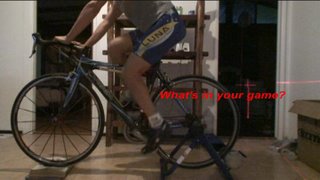
"E 'oni wale no 'oukou I ku'u pono, 'a'ole pau."
"Endless is the good that I have given to you to enjoy."
King Kamehameha I
What's in your game?
By the way there when you look west, as far as the eye can see is a big body water 1,500 feet below the house, a thick green jungle, full of many colorful plants & rare species of tropical birds birds? Off in the distance, to the right is a bay w/ black lava reaching into water. Shonny pointed out, w/ my Swarovski's I can view where Capt. Cook was killed by the natives.
Yes, they all use the term "Aloha" meaning hello,love, goodbye.

"E 'oni wale no 'oukou I ku'u pono, 'a'ole pau."
"Endless is the good that I have given to you to enjoy."
King Kamehameha I
What's in your game?
Saturday, November 25, 2006
A new age where Knowledge & Technique are King
All sports advance. Whether you're sixteen or sixty, male or female, beginner or expert-when you ride your bike you should know the best techniques. You don't have to be a super athlete, just bring whatever ability you have, and let us teach you to exploit what you are capable of doing. The only thing you need is a commitment to learn.
This is not the seventies and many technological breakthroughs have taken place. We have the tools to teach, to make you better. Bike designs w/ geometry & construction materials have also changed. Why then has bike fitting taken so long to change? Why should you be forced to use old outdated bike fitting info and methods? Why don't retail stores care? Who has the tools to unveil the "TRUTH" of what you need?
Think about it, you don't have to be in the know to own a retail store. And if you did own a store why would you care about how someone rides. That is not your concern! You only want your money from pushing whatever brand you have on the floor.
Great for the dealer, bad for the person who wants to learn.
Even if you have some sort of sizing cycle, tool, or a basic plum-line, it is not just about the fit. People want to learn the "TRUTH" and there are very few places that teach you how your muscles are firing w/in the pedal stroke. Yes, teaching the better techniques/movements of the world's best athletes to other cyclist at all ability levels we can be a primary influence in the sport. Yes, education is the way to help you understand the dynamics of cycling. Myo-facts sEMG/Dartfish is the key for that learning.
We are witnessing another technological breakthrough in cycling "TEACHING". But where does one go to get the biofeedback. Power meters only tell you the sum of the movements, it will not let you see what muscle is firing and when. So who is to say you need to have a certain bike setup w/o having the tools that provide the biofeedback data? Very soon, you will not have to take the word of someone who thinks you need something because they are the person who works on bikes every day, are your Coach,MD,PT,PA or they are the fastest fish in their pond! Very soon, dealers will hold the biofeedback tools that show you what you really need.
Thank goodness, for the power meter. The power meter has busted a lot of ideas on training how too! They are a great tool, but now we can even break it down to the single pedal stroke using Myo-facts sEMG/Dartfish. The game will never be the same!!!
Here is how change occurs! It was not long ago, that old classic cross country skiing (plum-line) vs. skating (Myo-facts sEMG/Dartfish), now that is the norm. After people learned the new skating, they describe it as "exciting...fast...dynamic...kinetic energy maximization..." But it took time for the results to change things. There where many professionals teaching the old school game. Nothing wrong w/ the old school, but it is not what won races. The same is being said after people use our Myo-facts sEMG/Dartfish. Old school meet new school, things are changing! In the mean time, many are going to have to learn from the old school of someone telling you what they think you need to do! Better? Perhaps? But if someone uses our Myo-facts sEMG/Dartfish, they see it, get and get better faster!
So what is a person to do? Here is how most retail stores work. Take skiing,you go buy your skis(bike), boots, etc..., at your local retail ski store, then you hit the slopes to learn on you own or you head to a ski school, or a join ski team to learn how to use them. Super, So where do you go to learn how to pedal? Who has the tools to teach you? Do you get a coach over the internet and instruct you? They don't have the biofeedback to show you what you need to do? Or you are very much on your own, after all there is not that much to riding a bike and I can keep up w/ my club. What's to learn anyway? The experts in my pond know! RIGHT!
It is ski season and as I look outside it is starting to snow. There are few hardcores jumping on their bikes for 2 1/2 hour ride. Perhaps everyone should get off the bike, get on the snow and learn how to bend a ski. It might do more for their pedal stroke and learning how to move than they know. Hope they have the focus and do the right moves or they are just learning bad motor skills for their base.
There is a lesson here, we learn from others and maybe we learn from the people we ride with? We know mass marketing impacts what we can learn. Ford is pushing their car & parts and Chevy are pushing their products. Then you have Porsche & BMW designs that perhaps care a bit more? Now think of the USA market and the 1,000 Chevy dealers and 1,000 Ford dealers? This is true, to become a dealer, you have to follow what they tell you. Sell,sell,sell!!! You don't make them money by teaching or caring how to drive the car. How about translating pedal power to the chain?
It's not the parts, it's how you put everything together. After that you still have to learn how to fire the muscles and learn the pedal stroke. Where can you go?
Why has cycling taken so long to unveil its secrets of movement? When Lance Armstrong was racing, do you think he was going to share w/ you what you need to do to take him out! Let's see, Tiger Woods is going to share w/ you what he knows to play on the PGA Tour? Come on! That is how they make their money.
So the next best thing is listen to the guy on TV who thinks they know what Lance or Tiger's muscle tone is when they make their moves. Do they know? Answer: NO! That is why they are now using software to break the movements down. The eye can't do that!
Back to the industry giants and how they have had a "gun-to-the-head" of their dealers. Dealing w/ specific fit needs "NOT". They want the dealers to sell bikes that they determine are the mass marketing needs. It cost the giants money to care!
Some brands market their brand by saying that if the dealer doesn't have their $$$$ sizing tool, plus 18 bikes on the floor, you don't become a dealer. Again, sizing a bike is some what a myth. We can fit you on a bike that is too small or too big. It mostly depends on what is it you want to do?
Just like skiing, we can fit you to long DH boards or shorter SL, but you will have a harder time dealing w/ the longer skis in tight turns or the bumps. So the question becomes what are the best-handling sizes for your game. Most brands come in sm,med,lg,xl to cover sizing. But the sales guy/gal has been told to sell what they have on the floor or else?
Look at skiing. Talk about understanding what is the best aero position. How getting your hands just so to mask your forearms, shaping your ski poles around everyhing allowing for a better tuck, allowing the eyes to see w/ the best head position, counter rotation, leg lead-change, hip angle allowing for the best use of the legs, all working as a moving counter weight for the legs to work. Understand in skiing, you can't make speed, you go w/ what the hill,surface and wind allows you.
Tiny margins make a huge difference in the sport of ski racing where 1,000th of a sec. makes a difference. And every country has their methods of looking for an edge! Skiers got into wind tunnels 30+ years ago! We found that sometimes being more aero will get you kill if your muscles don't work w/ the best range of motion at 45 to 70+mph. Look at the wrecks you see w/ tt setups!
This is important, we have a long history of looking for tiny margins. We know that is what makes a difference. Working w/ Olympic Champions from around the world. I mean people who won, not just one gold, but gold's! Working w/ the biggest names in the history of the skiing. Too many to name, but one comes to mind. James Major, the brother of Paul Major who was first a coach at CU, then being asked to work w/ the US Ski Team. James was the only North American named the head coach of a major European ski team. James Major was the coach for many years of World Cup, World Championship and Olympic medalist Ole Christian Furuseth. He used pictures to teach!
James is the co-author w/ Olle Larsson of a book "World Cup Technique"on ski technique and another on training methods. The book broke down the moves of the best in the game. They did not have the software we have today. He holds a Ph.D. in Exercise Physiology from the U of Utah. As I know, his wife Helde Aune from Norway is currently the assistant coach of the UC Davis Gymnastics team and the Program Director of the Davis Diamonds Gymnastics program. In addition to coaching ski racing, James has coached ski racers and gymnasts in gymnastics programs for almost 30 years.
Why is this important. Because we are new to coaching and we have been working w/ the physical demands of sports at the highest level true experts/coaches for years. From World Cup to Pro Tour to NCAA Champions! We have a rich history of success w/ many, long before all of the cycling success. We are not new to elite level sports.
I will say, what you learn in your pond might not be what is needed to make it in the ocean!
Take just using video and reflectors. You need to know that skin moves and you "Can Not" track the true joint angles, nor understand the extremity kinematics.
How can you determine the muscle activation (tone)that in truth determines the outcome?
Anyone who has spent any time at all skiing at the World Cup level knows that we can tune your skis for a given course (bevel edge angles), cant your ski under the binding or from the ski boot, or w/in the ski boot w/ a footbed. They all do different things. A footbed is use to reduce the lag time of any movement in any direction (inward/outward,forward,backward,etc...) And some would say, you don't need them. They can even hurt you if you don't know what correct!
Too much and the knees may wear out, or the hips, or your lower back. Too little and they don't do you any good, power can be lost. Your ankle angle is a very large part of being good in skiing, being able to feel the slope, as it is in cycling. To adjust the flex of a boot for correct angling is determined by the speed you can handle of any event (Sl,GS,SG,DH Bumps,Gen). In cycling is harder to learn, as you have to learn your angles in space. The heel is not providing feedback.
Further more, the person on skis needs to learn how to ski, timing, pole plants, one pole, two poles, etc..., when to pressure, when to get on/off edge, down-weight, up-weight, dive downhill, thrust the hips forward after the turn, where the hands need to be in space, counter rotation, and on & on. Then you have all the different events SL,GS,SG,DH plus getting more aero.
Sounds like a lot? It is! So the next time you jump on your bike, regardless of the setup and that might not be what you want, and it can even hurt you? Run all this through your mind.
Even w/ the perfect bike setup, using a Power Tap, SRM or Garmin, you still have to pedal, to learn to ride. And most important of all, how to fire your muscles!!!
This is not the seventies and many technological breakthroughs have taken place. We have the tools to teach, to make you better. Bike designs w/ geometry & construction materials have also changed. Why then has bike fitting taken so long to change? Why should you be forced to use old outdated bike fitting info and methods? Why don't retail stores care? Who has the tools to unveil the "TRUTH" of what you need?
Think about it, you don't have to be in the know to own a retail store. And if you did own a store why would you care about how someone rides. That is not your concern! You only want your money from pushing whatever brand you have on the floor.
Great for the dealer, bad for the person who wants to learn.
Even if you have some sort of sizing cycle, tool, or a basic plum-line, it is not just about the fit. People want to learn the "TRUTH" and there are very few places that teach you how your muscles are firing w/in the pedal stroke. Yes, teaching the better techniques/movements of the world's best athletes to other cyclist at all ability levels we can be a primary influence in the sport. Yes, education is the way to help you understand the dynamics of cycling. Myo-facts sEMG/Dartfish is the key for that learning.
We are witnessing another technological breakthrough in cycling "TEACHING". But where does one go to get the biofeedback. Power meters only tell you the sum of the movements, it will not let you see what muscle is firing and when. So who is to say you need to have a certain bike setup w/o having the tools that provide the biofeedback data? Very soon, you will not have to take the word of someone who thinks you need something because they are the person who works on bikes every day, are your Coach,MD,PT,PA or they are the fastest fish in their pond! Very soon, dealers will hold the biofeedback tools that show you what you really need.
Thank goodness, for the power meter. The power meter has busted a lot of ideas on training how too! They are a great tool, but now we can even break it down to the single pedal stroke using Myo-facts sEMG/Dartfish. The game will never be the same!!!
Here is how change occurs! It was not long ago, that old classic cross country skiing (plum-line) vs. skating (Myo-facts sEMG/Dartfish), now that is the norm. After people learned the new skating, they describe it as "exciting...fast...dynamic...kinetic energy maximization..." But it took time for the results to change things. There where many professionals teaching the old school game. Nothing wrong w/ the old school, but it is not what won races. The same is being said after people use our Myo-facts sEMG/Dartfish. Old school meet new school, things are changing! In the mean time, many are going to have to learn from the old school of someone telling you what they think you need to do! Better? Perhaps? But if someone uses our Myo-facts sEMG/Dartfish, they see it, get and get better faster!
So what is a person to do? Here is how most retail stores work. Take skiing,you go buy your skis(bike), boots, etc..., at your local retail ski store, then you hit the slopes to learn on you own or you head to a ski school, or a join ski team to learn how to use them. Super, So where do you go to learn how to pedal? Who has the tools to teach you? Do you get a coach over the internet and instruct you? They don't have the biofeedback to show you what you need to do? Or you are very much on your own, after all there is not that much to riding a bike and I can keep up w/ my club. What's to learn anyway? The experts in my pond know! RIGHT!
It is ski season and as I look outside it is starting to snow. There are few hardcores jumping on their bikes for 2 1/2 hour ride. Perhaps everyone should get off the bike, get on the snow and learn how to bend a ski. It might do more for their pedal stroke and learning how to move than they know. Hope they have the focus and do the right moves or they are just learning bad motor skills for their base.
There is a lesson here, we learn from others and maybe we learn from the people we ride with? We know mass marketing impacts what we can learn. Ford is pushing their car & parts and Chevy are pushing their products. Then you have Porsche & BMW designs that perhaps care a bit more? Now think of the USA market and the 1,000 Chevy dealers and 1,000 Ford dealers? This is true, to become a dealer, you have to follow what they tell you. Sell,sell,sell!!! You don't make them money by teaching or caring how to drive the car. How about translating pedal power to the chain?
It's not the parts, it's how you put everything together. After that you still have to learn how to fire the muscles and learn the pedal stroke. Where can you go?
Why has cycling taken so long to unveil its secrets of movement? When Lance Armstrong was racing, do you think he was going to share w/ you what you need to do to take him out! Let's see, Tiger Woods is going to share w/ you what he knows to play on the PGA Tour? Come on! That is how they make their money.
So the next best thing is listen to the guy on TV who thinks they know what Lance or Tiger's muscle tone is when they make their moves. Do they know? Answer: NO! That is why they are now using software to break the movements down. The eye can't do that!
Back to the industry giants and how they have had a "gun-to-the-head" of their dealers. Dealing w/ specific fit needs "NOT". They want the dealers to sell bikes that they determine are the mass marketing needs. It cost the giants money to care!
Some brands market their brand by saying that if the dealer doesn't have their $$$$ sizing tool, plus 18 bikes on the floor, you don't become a dealer. Again, sizing a bike is some what a myth. We can fit you on a bike that is too small or too big. It mostly depends on what is it you want to do?
Just like skiing, we can fit you to long DH boards or shorter SL, but you will have a harder time dealing w/ the longer skis in tight turns or the bumps. So the question becomes what are the best-handling sizes for your game. Most brands come in sm,med,lg,xl to cover sizing. But the sales guy/gal has been told to sell what they have on the floor or else?
Look at skiing. Talk about understanding what is the best aero position. How getting your hands just so to mask your forearms, shaping your ski poles around everyhing allowing for a better tuck, allowing the eyes to see w/ the best head position, counter rotation, leg lead-change, hip angle allowing for the best use of the legs, all working as a moving counter weight for the legs to work. Understand in skiing, you can't make speed, you go w/ what the hill,surface and wind allows you.
Tiny margins make a huge difference in the sport of ski racing where 1,000th of a sec. makes a difference. And every country has their methods of looking for an edge! Skiers got into wind tunnels 30+ years ago! We found that sometimes being more aero will get you kill if your muscles don't work w/ the best range of motion at 45 to 70+mph. Look at the wrecks you see w/ tt setups!
This is important, we have a long history of looking for tiny margins. We know that is what makes a difference. Working w/ Olympic Champions from around the world. I mean people who won, not just one gold, but gold's! Working w/ the biggest names in the history of the skiing. Too many to name, but one comes to mind. James Major, the brother of Paul Major who was first a coach at CU, then being asked to work w/ the US Ski Team. James was the only North American named the head coach of a major European ski team. James Major was the coach for many years of World Cup, World Championship and Olympic medalist Ole Christian Furuseth. He used pictures to teach!
James is the co-author w/ Olle Larsson of a book "World Cup Technique"on ski technique and another on training methods. The book broke down the moves of the best in the game. They did not have the software we have today. He holds a Ph.D. in Exercise Physiology from the U of Utah. As I know, his wife Helde Aune from Norway is currently the assistant coach of the UC Davis Gymnastics team and the Program Director of the Davis Diamonds Gymnastics program. In addition to coaching ski racing, James has coached ski racers and gymnasts in gymnastics programs for almost 30 years.
Why is this important. Because we are new to coaching and we have been working w/ the physical demands of sports at the highest level true experts/coaches for years. From World Cup to Pro Tour to NCAA Champions! We have a rich history of success w/ many, long before all of the cycling success. We are not new to elite level sports.
I will say, what you learn in your pond might not be what is needed to make it in the ocean!
Take just using video and reflectors. You need to know that skin moves and you "Can Not" track the true joint angles, nor understand the extremity kinematics.
How can you determine the muscle activation (tone)that in truth determines the outcome?
Anyone who has spent any time at all skiing at the World Cup level knows that we can tune your skis for a given course (bevel edge angles), cant your ski under the binding or from the ski boot, or w/in the ski boot w/ a footbed. They all do different things. A footbed is use to reduce the lag time of any movement in any direction (inward/outward,forward,backward,etc...) And some would say, you don't need them. They can even hurt you if you don't know what correct!
Too much and the knees may wear out, or the hips, or your lower back. Too little and they don't do you any good, power can be lost. Your ankle angle is a very large part of being good in skiing, being able to feel the slope, as it is in cycling. To adjust the flex of a boot for correct angling is determined by the speed you can handle of any event (Sl,GS,SG,DH Bumps,Gen). In cycling is harder to learn, as you have to learn your angles in space. The heel is not providing feedback.
Further more, the person on skis needs to learn how to ski, timing, pole plants, one pole, two poles, etc..., when to pressure, when to get on/off edge, down-weight, up-weight, dive downhill, thrust the hips forward after the turn, where the hands need to be in space, counter rotation, and on & on. Then you have all the different events SL,GS,SG,DH plus getting more aero.
Sounds like a lot? It is! So the next time you jump on your bike, regardless of the setup and that might not be what you want, and it can even hurt you? Run all this through your mind.
Even w/ the perfect bike setup, using a Power Tap, SRM or Garmin, you still have to pedal, to learn to ride. And most important of all, how to fire your muscles!!!
Wednesday, November 22, 2006
A preview of a Mythbuster coming in Jan 2007
This is the real deal. This is not some toy! Myo-facts sEMG/Dartfish is changing the level of understanding.
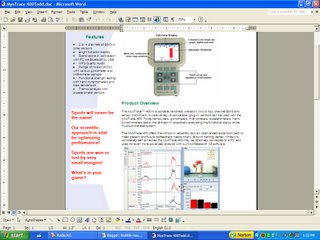
Do you want to know how your muscles really work? How your motor unit recruitment patterns occur. Muscle tone provides the basis for resistance to gravity's pull, emotional tone, leading to your best movement. Without this biofeedback you are only guessing. Do you really want to waste your time on bad motor skills?
The pull of gravity is ubiquitous, and the muscles must respond to this call. On the other hand, if muscle fibers fired continuously in order to counter this force, they would soon become exhausted.
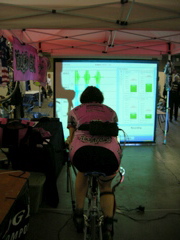
This means that the central nervous system rotates which motor units are firing w/in a given muscle group. We can show you what your muscles are doing long before you find the sum of muscles by only reading the wattage!

Do you want to know how your muscles really work? How your motor unit recruitment patterns occur. Muscle tone provides the basis for resistance to gravity's pull, emotional tone, leading to your best movement. Without this biofeedback you are only guessing. Do you really want to waste your time on bad motor skills?
The pull of gravity is ubiquitous, and the muscles must respond to this call. On the other hand, if muscle fibers fired continuously in order to counter this force, they would soon become exhausted.
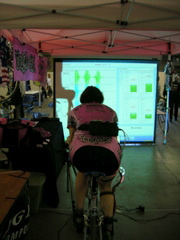
This means that the central nervous system rotates which motor units are firing w/in a given muscle group. We can show you what your muscles are doing long before you find the sum of muscles by only reading the wattage!
Monday, November 20, 2006
Congratulations To Georgia Gould (Luna) 2nd Overall in the USGP
What a season she had! You can't ask for more from anyone. She is one tough gal.
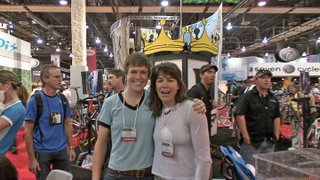 Note the two crowns above in the background! I didn't see it when I took the pic. I guess I should had moved to their right more to get the crowns over their heads. How funny!!!
If you don't know Georgia's face, she is the one on your left. Both gals where mtb 2006 NORBA champions, Georgia in mtb XC & Reba in mtb 24 hour. We have some really tough girls in Idaho.
Science has helped separate Georgia from the pack w/ cutting-edge techniques. This science allowed her to widen her (know how) lead over the competition. If you intend on racing w/ the pros, optimal racing performance is needed in this grueling sports event. These races are won or lost by very small margins.
At this level, a scientific approach is vital for optimizing performance.
Georgia Gould has a bright future!!!
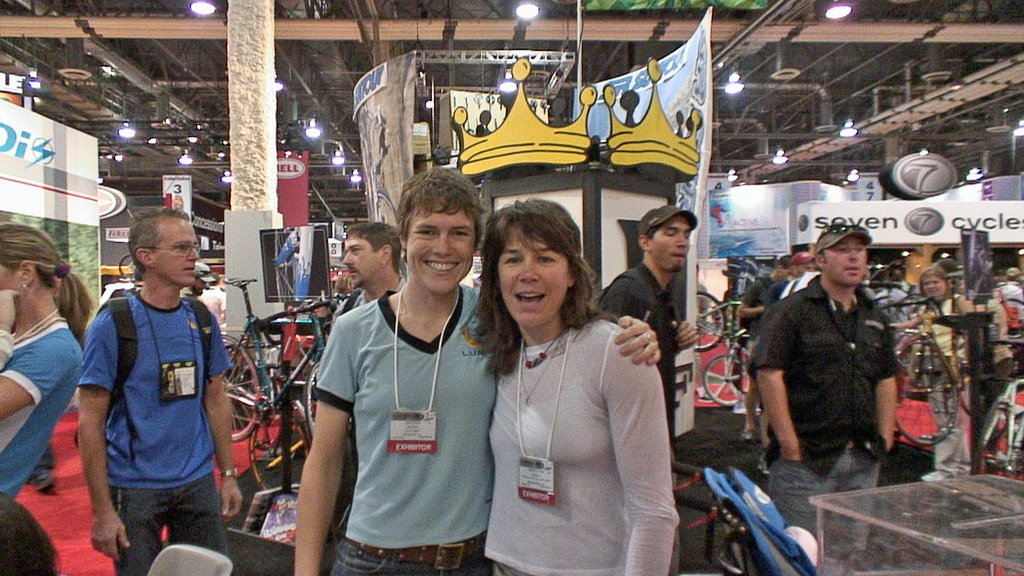 Note the two crowns above in the background! I didn't see it when I took the pic. I guess I should had moved to their right more to get the crowns over their heads. How funny!!!
If you don't know Georgia's face, she is the one on your left. Both gals where mtb 2006 NORBA champions, Georgia in mtb XC & Reba in mtb 24 hour. We have some really tough girls in Idaho.
Science has helped separate Georgia from the pack w/ cutting-edge techniques. This science allowed her to widen her (know how) lead over the competition. If you intend on racing w/ the pros, optimal racing performance is needed in this grueling sports event. These races are won or lost by very small margins.
At this level, a scientific approach is vital for optimizing performance.
Georgia Gould has a bright future!!!
Sunday, November 19, 2006
What does it take?
What does it take for an young smart individual to race some of the most knowledgeable elite-level racers on earth? To battle North American's national champions.
Think about it, you are a newcomer and you have captured the lead in the USGP series until the very last day. There is only one race left and you have a chance to take the championships. How cool is that?
A big part of one's success and career is by "Demystifyling" how you bike is set up, what your muscles should be doing, not what you think they should because someone said so? You can't waist your racing career/seasons w/ confusing information. Sure you can read this and that and you will hear everything. But the numbers of sEMG don't lie.
Bold moves by Georgia placed her at the top of the elite-level cyclists,wearing the USGP leader's jersey for most of this 2006 season. Georgia was smart enough to take time (6 hours) to learn the "TRUTH" about your pedal stroke. Most just guess and go ride. She knows that she has taken it to the next level. Knowing truth is power!
With a second-place finish by Bessette and Gould's fourth-place finish, Bessette regained the USGP leader's jersey she relinquished to Gould after Gould's victory in Gloucester. Compton missed the opening weekend of USGP racing and is not in contention for the USGP title. Bessette now leads Gould by only six points.
It has been a "Great Run" by Georgia Gould no matter of the outcome today! What a year she has had.
Think about it, you are a newcomer and you have captured the lead in the USGP series until the very last day. There is only one race left and you have a chance to take the championships. How cool is that?
A big part of one's success and career is by "Demystifyling" how you bike is set up, what your muscles should be doing, not what you think they should because someone said so? You can't waist your racing career/seasons w/ confusing information. Sure you can read this and that and you will hear everything. But the numbers of sEMG don't lie.
Bold moves by Georgia placed her at the top of the elite-level cyclists,wearing the USGP leader's jersey for most of this 2006 season. Georgia was smart enough to take time (6 hours) to learn the "TRUTH" about your pedal stroke. Most just guess and go ride. She knows that she has taken it to the next level. Knowing truth is power!
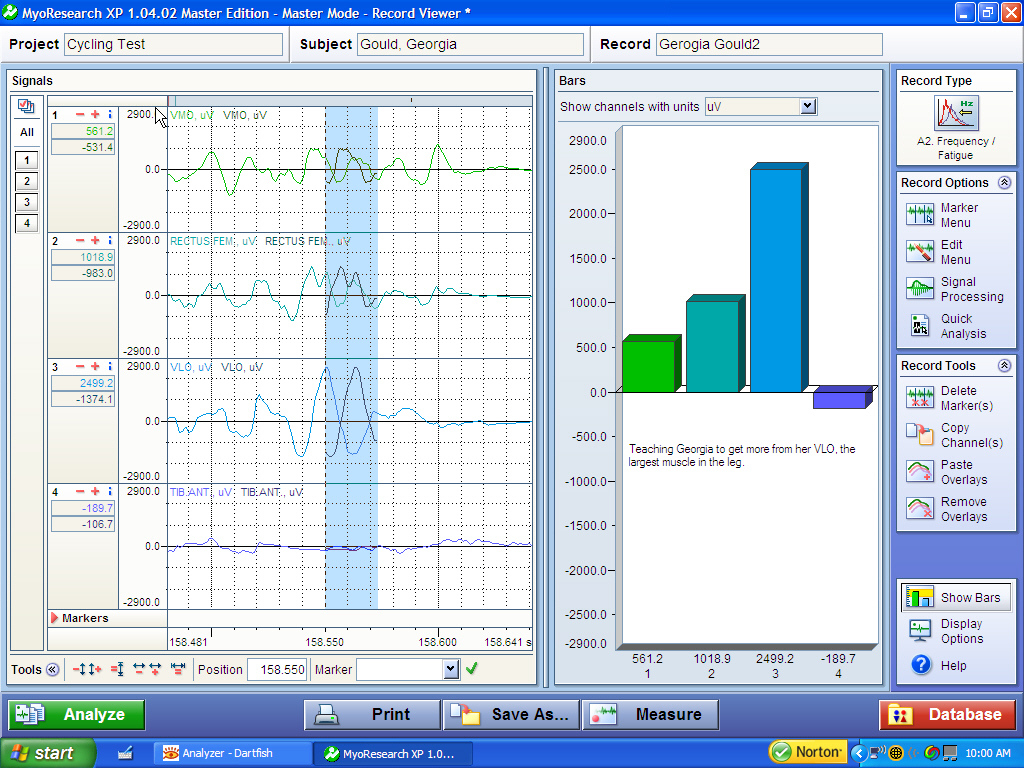
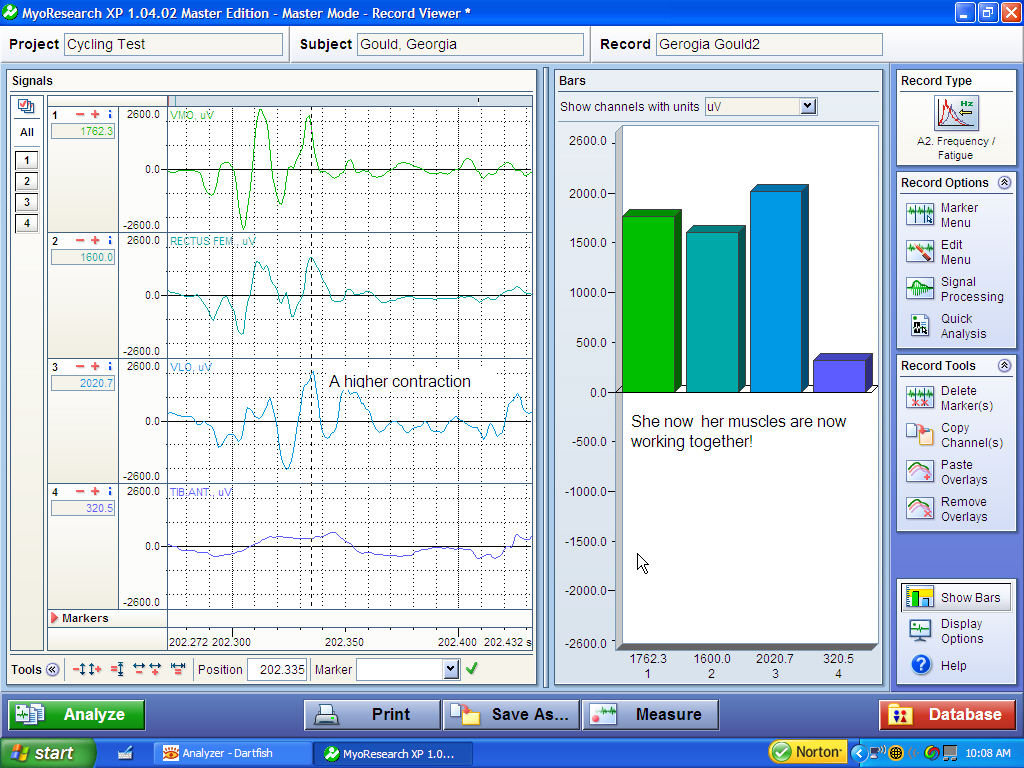
With a second-place finish by Bessette and Gould's fourth-place finish, Bessette regained the USGP leader's jersey she relinquished to Gould after Gould's victory in Gloucester. Compton missed the opening weekend of USGP racing and is not in contention for the USGP title. Bessette now leads Gould by only six points.
It has been a "Great Run" by Georgia Gould no matter of the outcome today! What a year she has had.
Saturday, November 18, 2006
Go to our Results and see what we do!
While sitting and attempting to describe to a freind what we do, I had Joe Brungardt who is a teacher to provide feedback on how he see's what we do. Here is his thoughts.
Consistency is the name of the game. Since 2001, when we took 5 National Championships up through this year 2006 season our count was around 20 National Championships in 2006 alone, plus a world.)
How do you backup what works? Our results speak for themselves!
Consistency is the name of the game. Since 2001, when we took 5 National Championships up through this year 2006 season our count was around 20 National Championships in 2006 alone, plus a world.)
How do you backup what works? Our results speak for themselves!
Thursday, November 16, 2006
YOU HAVE TO SEE THIS!
 We can teach you inside!
We can provide graphs that make it easy to understand!

We can even go outside!
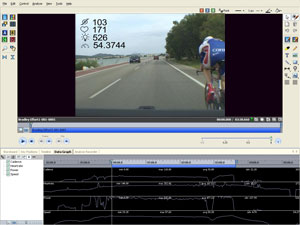
We can focus on the game you want to play (road,tt,mtb,track,cyclocross,et...)
What is it you want to know?
Think about watching, learning everything you motor is doing i.e. which muscle is firing and how much and at what time, your heart rate, your cadence, your wattage, your speed and finding angles that make a difference? The game will never be the same!
Myo-facts sEMG/Dartfish "Truth Inside & Out." while on your bike anywhere!
More than a promise, it's how we do business. What's in your game?
Coming Soon!
What is the "Truth" about your cleat placement?
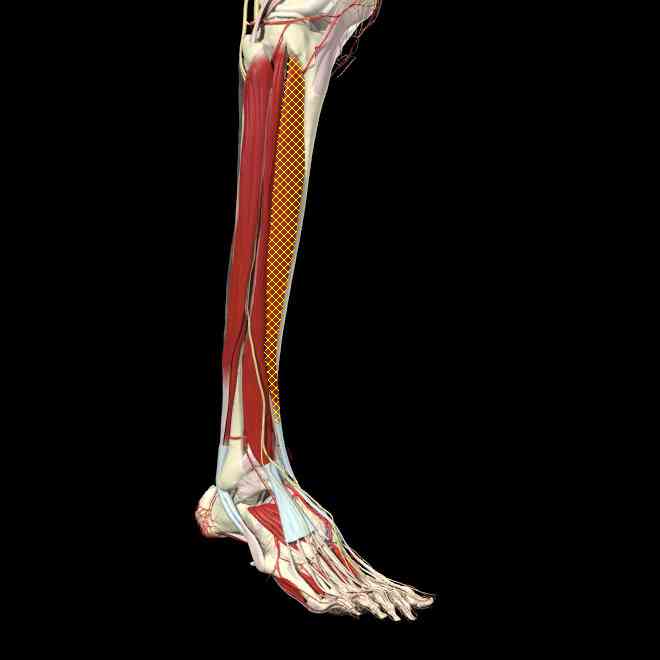
You hear and read everything about cleat placement. Do this, try this,etc... You never hear info on what muscles impact your pedal stroke? No one talks about "what is the best line of pull for the muscles that make a difference? They don't even inform you about what muscle needs the "best range of motion"?
General info is just that!!! Most people don't understand that by adding a footbed changes the cleat placement? How can you determine the contraction of a muscle in question w/o using sEMG? How can you determine the best line of pull of muscles w/o Myo-facts sEMG/Dartfish?
Free advise is just that, very general at the least? After all it is "Free." We don't care to waste our time nor yours w/ the generals, that is why we use science to nail the "Truth" about things.
Do your homework and study! It will do you well to study the Tibialis anterior and Extensor digitorum longus "why focus" on it? True, we not free, nor was our schooling & tools, they costed us huge time and money, but its correct when you leave.
Subscribe to:
Posts (Atom)

